 Words by
A painting by Hilma af Klint about the size of a hardcover atlas sold in Stockholm on Thursday for 128.9 million Swedish kronor, about $12.7 million with fees. It is a record for the artist and, according to the auction house, Bukowskis, the most expensive work of art ever sold at auction in the Nordic region.
The work, “Ser III No. 5,” is an abstraction in oil and graphite on canvas, dated Jan. 18, 1920, and measures 38.5 by 29 centimeters, roughly 15 by 11 inches. Bukowskis had estimated it at 6 million to 8 million kronor. The hammer fell at 108 million, more than 13 times the top of that range, after what the house described as “intense bidding between multiple clients.” The buyer was not named.
“It is remarkable in itself to sell an abstract work by Hilma af Klint,” Bukowskis CEO Louise Arén said in the house’s results announcement. “The exceptional final price marks a historic moment.”
A painter the market almost never sees
The price says as much about scarcity as about taste. Af Klint (1862-1944) made most of her abstract work for no buyer at all, and nearly all of it now belongs to the Hilma af Klint Foundation in Stockholm. Only two of her abstract paintings had ever been sold at auction before this one, both more than 30 years ago, Bukowskis said.
“Ser III No. 5” got out through a narrow door. The lot’s provenance traces it from the artist’s estate to her nephew, Vice Admiral Erik af Klint, who gave it to the foundation in 1972. In 1990 it was transferred to Stiftelsen Antroposofins Hus, an anthroposophical foundation, and in 1995 a private collector bought it through Galleri Söderlund in Stockholm. It stayed with that family until last week.
The painting had been seen in public before. It hung in “The Spiritual in Art: Abstract Painting 1890-1985,” the 1986 show that opened at the Los Angeles County Museum of Art and introduced af Klint’s abstractions to an international audience, and in the Moderna Museet retrospective in Stockholm in 1989 and 1990.
From séances to the Guggenheim
Af Klint trained as a painter in Stockholm and exhibited naturalistic landscapes from her own studio near Kungsträdgården, according to Bukowskis. Her interest in spiritualism, and later in Rudolf Steiner’s anthroposophy, pushed her work somewhere else entirely. She described receiving instructions during séances and translated them into large, diagrammatic paintings of spirals, petals, letters and color fields.
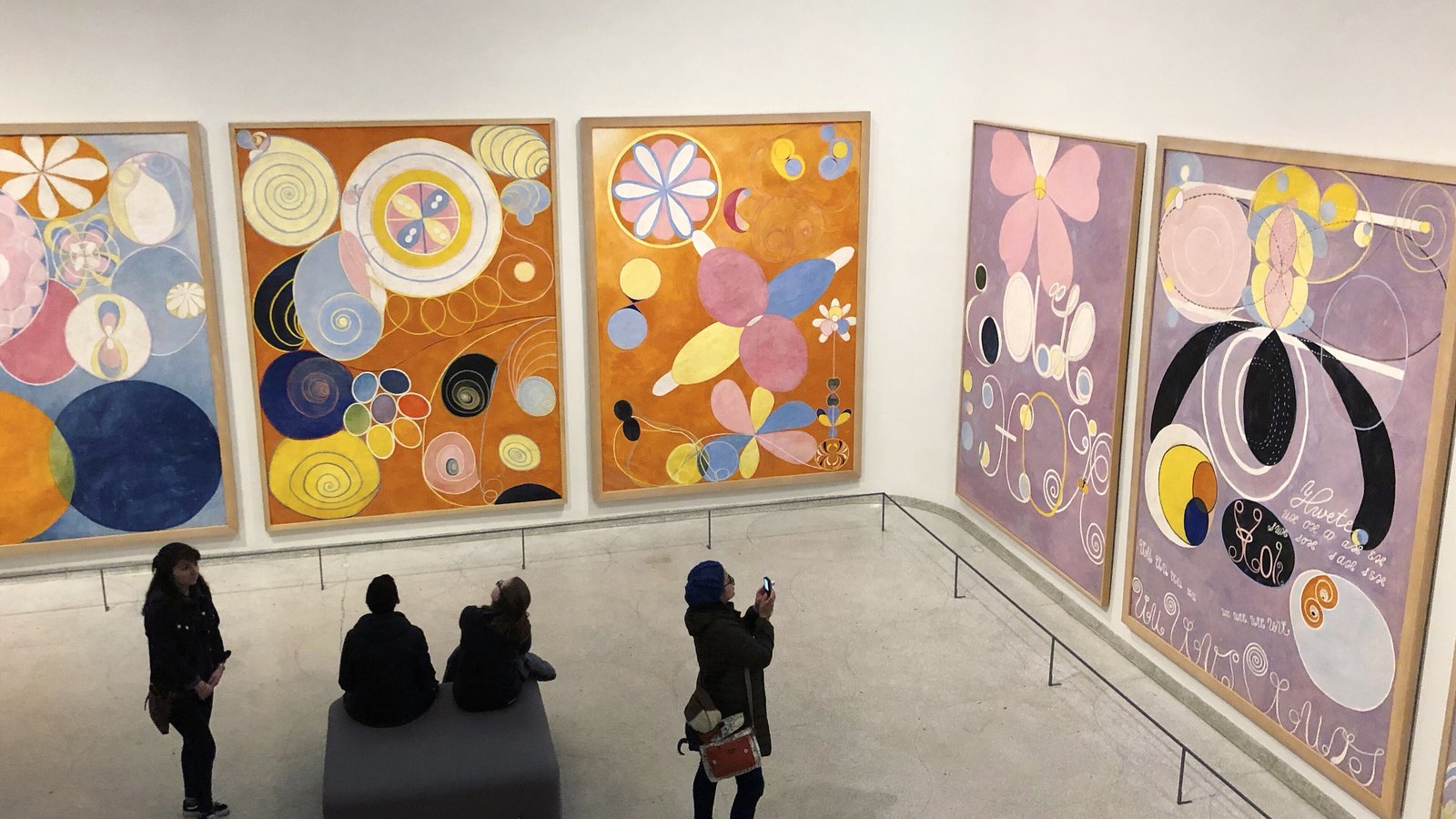
Bukowskis’ catalog notes that she had developed an abstract visual language by 1906, several years before Wassily Kandinsky, Piet Mondrian and Kazimir Malevich, the painters long credited with inventing abstraction. Her best-known series, “The Ten Largest” of 1907, is a set of roughly 10-foot canvases on the stages of human life, and it hung at the Solomon R. Guggenheim Museum in New York in the 2018-19 survey “Hilma af Klint: Paintings for the Future,” which became the most-visited exhibition in the museum’s history.
“Ser III No. 5” comes from a later, quieter period. By 1920 af Klint had moved to smaller, more geometric series, and her catalogue raisonné places the work in its volume on geometric series and other works from 1917 to 1920.
Should it have been sold?
Not everyone celebrated. The foundation and some of af Klint’s descendants have long argued that her abstract work was never meant to be a commodity, and the sale reopened that argument. Rachel Villari, an art historian who wrote her dissertation on af Klint, told NPR before the sale that “if it’s sold, the public won’t be able to ever see that painting or have access to it again.”
For collectors, that is the point and the problem. With so few af Klint abstractions in private hands, a single result now sets the benchmark for any that surface later. For everyone else, the work is easier to see in museums than it has ever been. Moderna Museet in Stockholm keeps a room for her in its permanent collection, with works rotated regularly, according to Bukowskis.
The sale lands in a busy season for the art business, covered in our look at how the auction business works at Sotheby’s. For more on the artists, designers and performers shaping the conversation, see our Profiles and Culture sections, including the Design Museum’s new “Nue Black Aesthetic” exhibition.
Add Amore Magazine as a preferred source on Google (opens in a new tab)